How Big Is a Baby Monk Seal How Heavy?
| Monk seals | |
|---|---|
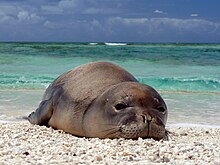 | |
| Hawaiian monk seal | |
Scientific nomenclature  | |
| Kingdom: | Animalia |
| Phylum: | Chordata |
| Class: | Mammalia |
| Order: | Carnivora |
| Clade: | Pinnipedia |
| Family: | Phocidae |
| Subfamily: | Monachinae |
| Tribe: | Monachini Scheffer, 1958 |
| Species | |
| Monachus monachus | |
 | |
| Hawaiian monk seal range | |
 | |
| Mediterranean monk seal range | |
Monk seals are earless seals of the tribe Monachini. They are the only earless seals found in tropical climates. The two genera of monk seals, Monachus and Neomonachus, incorporate three species: the Mediterranean monk seal, Monachus monachus; the Hawaiian monk seal, Neomonachus schauinslandi; and the Caribbean monk seal, Neomonachus tropicalis, which became extinct in the 20th century. The two surviving species are now rare and in imminent danger of extinction. All iii monk seal species were classified in genus Monachus until 2014, when the Caribbean area and Hawaiian species were placed into a new genus, Neomonachus.
Monk seals have a slender body and are agile. They have a broad, apartment snout with nostrils on the tiptop. Monk seals are polygynous, and group together in harems. They feed mainly on bony fish and cephalopods, but they are opportunistic. The skin is covered in modest hairs, which are more often than not blackness in males and brown or night gray in females. Monk seals are found in the Hawaiian archipelago, certain areas in the Mediterranean Sea (such equally Cabo Blanco, Ciolo in Apulia , Gyaros island)and Aeolian Islands, and formerly in the tropical areas of the west Atlantic Ocean.
All species experienced overhunting by sealers. The Hawaiian monk seal experienced population drops in the 19th century and during World War II, and the Caribbean area monk seal was exploited since the 1500s until the 1850s, when populations were too low to hunt commercially. The Mediterranean monk seal has experienced commercial hunting since the Middle Ages and eradication by fishermen. Monk seals have adult a fear of humans, and may even abandon beaches due to human being presence. Currently, around 1,700 monk seals remain.
Taxonomy and evolution [edit]
| |||||||||||||||||||||
| Phylogenetic relations between monk seals and other earless seals [i] |
Monk seals are earless seals (truthful seals) of the tribe Monachini.[2] The tribe was first conceived past Victor Blanchard Scheffer in his 1958 book Seals, Sea Lions, and Walruses: A Review of the Pinnipedia.[3] The two genera of monk seals, Monachus and Neomonachus, contain three species: the Mediterranean monk seal (Monachus monachus), the Hawaiian monk seal (Neomonachus schauinslandi), and the Caribbean monk seal (N. tropicalis), which became extinct in the 20th century. All three monk seal species were classified in genus Monachus until 2014, when comparing of the species' mitochondrial cytochrome b Dna sequences led biologists to place the Caribbean and Hawaiian species in a new genus, Neomonachus.[4] [5]
Fossils of the Mediterranean and Caribbean species are known from the Pleistocene.[1] The time of deviation between the Hawaiian and Caribbean area species, three.7 million years ago (Mya), corresponds to the endmost of the Central American Seaway by the formation of the Isthmus of Panama. The divergence betwixt Mediterranean seals and the New World clade was dated to half-dozen.3 Mya agone.[half dozen]
Fossils of a Pliocene species of monk seal, Eomonachus belegaerensis, have been found in Taranaki region of New Zealand. This could maybe place the origins of the group in the Southern Hemisphere.[7] [8] The only other fossil monk seal is Pliophoca etrusca, from the tardily Pliocene of Italia.[9]
Habitat [edit]

Hawaiian monk seal hauled out on volcanic rock
The Hawaiian monk seal, as the name suggests, lives solely in the Hawaiian archipelago. Monk seals migrated to Hawaii between four–11 Mya through an open-water passage betwixt North and South America called the Fundamental American Seaway. The Isthmus of Panama airtight the seaway 3 Mya. The species may have evolved in the Pacific or Atlantic, but in either instance, came to Hawaii long before the kickoff Polynesians.[ten] When monk seals are non hunting or eating, they by and large savor on the beaches; Hawaiian monk seals tend to enjoy on sandy beaches and volcanic rock of the Northwest Hawaiian Islands.[xi]
The habitat of the Mediterranean monk seal has inverse over the years. Prior to the 20th century, they had been known to congregate, give birth, and seek refuge on open up beaches. Since sealing had concluded, they have left their former habitat and at present just employ sea caves for such beliefs. Generally, these caves are rather inaccessible to humans due to underwater entries, and because the caves are often forth remote or rugged coastlines. Scientists accept confirmed this is a recent adaptation, most probable due to the rapid increase in homo population, tourism, and manufacture, which accept caused increased disturbance by humans and the destruction of the species' natural habitat. Because of these seals' shy nature and sensitivity to human disturbance, they have slowly adjusted to try to avoid contact with humans completely within the last century, and perhaps, even earlier. The littoral caves are, yet, unsafe for newborns, and are causes of major mortality amidst pups when ocean storms striking the caves.[12]
Caribbean area monk seals were plant in warm temperate, subtropical, and tropical waters of the Caribbean Sea, Gulf of Mexico, and the w Atlantic Ocean. They probably preferred to booty out at sites (low sandy beaches to a higher place high tide) on isolated and secluded atolls and islands, but occasionally visited the mainland coasts and deeper waters offshore. This species may have fed in shallow lagoons and reefs.[13]
Description [edit]
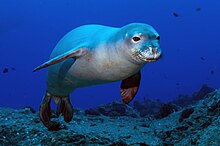
Hawaiian monk seal swimming (notation the red eyes are due to the red-eye effect)
Monk seals are part of the family Phocidae (earless seals), the members of which are characterized by their lack of external ears, the inability to rotate the hind flippers nether the body,[fourteen] and shed their hair and the outer layer of their skin in an annual molt.[15] Monk seals as a whole vary minutely in size, with all adults measuring on average viii feet (2.four m) and 500 pounds (230 kg). They showroom sexual dimorphism, in that the males are slightly larger than females, with the exception of the Hawaiian monk seal, where females are larger. Its white abdomen, gray coat, and slender physique distinguish it from the harbor seal (Phoca vitulina), another earless seal.[13] [16] [17] Much similar elephant seals, they shed their hair and the outer layer of their skin in an almanac molt.[xv]
The Mediterranean monk seal has a brusk, broad, and apartment snout, with very pronounced, long nostrils that face upwardly. The flippers are relatively brusque, with small, slender claws. The monk seal'due south physique is ideally suited for hunting its prey: fish, octopus, lobster, and squid in deep-water coral beds.[18] The fur coats of males is generally black, and dark-brown or dark gray in females. Pups are about 3.3 feet (ane 1000) long and counterbalance around 33–40 pounds (xv–18 kg), their peel being covered by 0.4-to-0.6-inch (1.0 to ane.5 cm) fur, usually dark brown or black. On their bellies, a white stripe occurs, which differs in color between the two sexes. This hair is replaced later on 6–8 weeks by the usual short hair adults carry.[16]

Mediterranean monk seal skeleton
The Hawaiian monk seal (whose Hawaiian name means "the dog that runs in rough waters")[19] has a curt, broad, and apartment snout, with long nostrils that confront forward. It has a relatively small, flat caput with big, black optics, eight pairs of teeth, and a short snout with the nostrils on superlative of the snout and vibrissae on each side.[17] The nostrils are minor, vertical slits, which close when the seal dives nether water. Additionally, their slender, torpedo-shaped body and hind flippers allow them to be very agile swimmers.[20] Adult males are 300 to 400 pounds (140 to 180 kg) in weight and 7 feet (2.ane m) in length, while adult females tend to exist, typically, slightly larger, at 400 to 600 pounds (180 to 270 kg) and 8 feet (2.4 k) in length. When monk seal pups are born, they weigh 30 to 40 pounds (14 to eighteen kg) and are 40 inches (one.0 m) in length. Equally they nurse for about 6 weeks, they grow considerably, eventually weighing between 150 and 200 pounds (68 and 91 kg) by the time they are weaned, while the female parent loses up to 300 pounds (140 kg).
Caribbean monk seals had a relatively large, long, robust body, and could grow to nigh 8 feet (ii.four m) in length and weighed 375 to 600 pounds (170 to 272 kg). Males were probably slightly larger than females, which is like to Mediterranean monk seals. Like other monk seals, this species had a distinctive head and face up. The head was rounded with an extended, wide muzzle. The confront had relatively large, wide-spaced eyes, upward-opening nostrils, and fairly large whisker pads with long, light-colored, and smooth whiskers. When compared to the body, the animal's foreflippers were relatively brusque with lilliputian claws and the hindflippers were slender. Their coloration was dark-brown and/or grayish, with the underside lighter than the dorsal area. Adults were darker than the paler and more yellowish younger seals. Caribbean monk seals were likewise known to accept algae growing on their pelages, giving them a slightly light-green appearance, which is similar to Hawaiian monk seals.[13]
Behavior [edit]
Nutrition and predation [edit]
Hawaiian monk seals mainly prey on reef-dwelling bony fish, merely they too casualty on cephalopods and crustaceans. Juveniles and subadults casualty more on smaller octopus species, such every bit Octopus leteus and O. hawaiiensis (nocturnal octopus species), and eels than practice developed Hawaiian monk seals. Adult seals feed mostly on larger octopus species such equally O. cyanea. Hawaiian monk seals have a wide and various nutrition due to foraging plasticity, which allows them to be opportunistic predators that feed on a wide multifariousness of bachelor prey.[eighteen] Tiger sharks, smashing white sharks, and Galapagos sharks are all predators of the Hawaiian monk seal.[21]
Mediterranean monk seals are diurnal and feed on a variety of fish and mollusks, primarily octopus, squid, and eels, up to 6.v pounds (ii.9 kg) per day. They are known to provender mostly at depths of 150 to 230 feet (46 to seventy chiliad), merely some have been observed by NOAA submersibles at a depth of 500 feet (150 chiliad). They adopt hunting in wide-open spaces, enabling them to use their speed more finer. They are successful bottom-feeding hunters; some have fifty-fifty been observed lifting slabs of stone in search of prey. They have no natural predators.[16]
Reproduction and development [edit]

2 young Hawaiian monk seals
Very piffling is known of the Mediterranean monk seal'due south reproduction. They are thought to be polygynous, with males beingness very territorial where they mate with females. Although no convenance flavor exists, since births have identify year round, a meridian occurs in October and November. This is also the time when caves are prone to wash out due to high surf or tempest surge, which causes high mortality rates among pups, especially at the cardinal Cabo Blanco colony. Pups brand commencement contact with the water 2 weeks after their nascency and are weaned around 18 weeks of historic period; females caring for pups get off to feed for an average of 9 hours.[16] Most individuals are believed to reach maturity at four years of age. The gestation period lasts shut to a year. However, monk seals of the Cabo Blanco colony may have a gestation flow lasting slightly longer than a year.[22] : 97 Mediterranean monk seals generally alive to be 25 to 30 years old.[12]
Hawaiian monk seals are polygynous. The breeding flavour takes identify throughout the yr, excluding the autumn, just peaks during Apr and May. Shark attacks crusade a high pup bloodshed, from nineteen% to 39%. Pups are thought to be weaned around 6 weeks and reach sexual maturity at 3 years.[22] : 104–105 Their typical lifespan is 25 to xxx years.[xix]
Not much is known of the Caribbean area monk seal'southward reproduction. They probable bore a single pup every two years. Their gestation period, lactation period, and sexual maturity age are unknown.[22] : 102
Interactions with humans [edit]
Hawaii [edit]
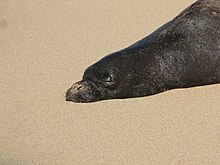
Hawaiian monk seal sleeping on a beach in Kauai
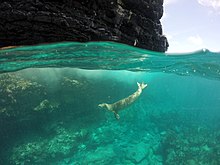

Immature monk seal underwater
Threats [edit]
In the 19th century, many seals were killed by whalers and sealers for meat, oil, and skin.[23] U.S. military forces hunted them during Earth War II, while occupying Laysan Island and Midway Island.[23] Human disturbances have had immense furnishings on the populations of the Hawaiian monk seal. They tend to avert beaches where they are disturbed; after continual disturbance, the seals may completely abandon the beach, thus reducing habitat size, later limiting population growth. For example, large embankment crowds and beach structures limit the seal's habitat. The WWII military bases in the northwestern islands were closed, but minimal man activities can be enough to disturb the species.[24] The current population is only around 1,400 individuals.[25]
The Hawaiian monk seal has the lowest level of genetic variability among the 18 pinniped species, allegedly due to a population bottleneck caused by intense hunting in the 19th century. This limited genetic variability reduces the species's power to arrange to environmental pressures and limits natural choice, thus increasing their risk of extinction. Given the monk seal's small-scale population, the effects of disease could be disastrous.[26] [27]
Entanglement can result in mortality, considering when the seals get trapped in marine debris such as fishing nets, they cannot maneuver or attain the surface to breathe.[26] Marine fisheries can potentially interact with monk seals by direct and indirect relationships. Directly, the seal can become snared by fishing equipment, entangled in discarded debris, and even feed on fish refuse.[24] International police force prohibits the intentional discarding of debris from ships at body of water. Monk seals have ane of the highest documented rates of entanglement of any pinniped species.[24]
Conservation [edit]
In 1909, Theodore Roosevelt created the Hawaiian Islands National Wildlife Refuge (HINWR), which is under the jurisdiction of the U.S. Fish and Wildlife Service.[24] Throughout the 1980s, the National Marine Fisheries Service completed various versions of an environmental impact statement that designated the Northwest Hawaiian Islands equally a critical habitat for the Hawaiian monk seal. The designation prohibited lobster fishing in the northwest Hawaiian Islands and Laysan Isle. In 2006, a Presidential proclamation established the Papahanaumokuakea Marine National Monument, which incorporated the Northwestern Hawaiian Islands Coral Reef Ecosystem Reserve, the Midway Atoll National Wildlife Refuge, the HINWR, and the Battle of Midway National Memorial, thus creating the largest marine protected area in the world and affording the Hawaiian monk seal further protection.[28]
NOAA cultivated a network of volunteers to protect the seals while they bask or carry and nurse their young. NOAA is funding considerable research on seal population dynamics and wellness in conjunction with the Marine Mammal Middle. From NOAA, several programs and networks were formed. Customs programs such every bit PIRO have helped to ameliorate community standards for the Hawaiian monk seal. The program besides creates networks with the native Hawaiians on the isle to network more than people in the fight for conservation of the seals. The Marine Mammal Response Network is partnered with NOAA and several other regime agencies that deal with country and marine wildlife.[29]
To raise awareness of the species' plight, on June eleven, 2008, a country police force designated the Hawaiian monk seal as Hawaii's official state mammal.[thirty]
Mediterranean [edit]

Threats [edit]
Several causes provoked a dramatic population decrease over time: on one hand, commercial hunting (peculiarly during the Roman Empire and Middle Ages) and during the 20th century, eradication by fishermen, who used to consider it a pest due to the damage the seal causes to angling nets when it preys on fish caught in them; and on the other paw, coastal urbanization and pollution. Currently, its entire population is estimated to be less than 600 individuals scattered throughout a broad distribution range, which qualifies this species as endangered. Its electric current very thin population is ane more serious threat to the species, as it only has two fundamental sites that tin be deemed viable. One is the Aegean Sea (250–300 animals in Greece, with the largest concentration of animals on Gyaros,[31] and some 100 in Turkey); the other important subpopulation is the Western Saharan portion of Cabo Blanco (effectually 200 individuals which may support the modest, just growing, nucleus in the Desertas Islands – roughly 20 individuals[sixteen]). Some individuals may be using coastal areas along other parts of Western Sahara, such as in Cintra Bay.[32] These ii cardinal sites are almost in the extreme opposites of the species' distribution range, which makes natural population interchange betwixt them impossible. All the other remaining subpopulations are composed of less than 50 mature individuals, many of them being only loose groups of extremely reduced size – often less than v individuals.[16] Consequently, low genetic variability exists.[33]

A colony of Mediterranean monk seals on Cabo Blanco, 1945
Cabo Blanco, in the Atlantic Sea, is the largest surviving single population of the species, and the but remaining site that all the same seems to preserve a colony structure.[16] In the summer of 1997, a disease killed more than than 200 animals (two-thirds of its population) within two months, extremely compromising the species' feasible population. While opinions on the precise causes of this epidemic remain divided, the nearly likely cause is a morbilivirus or a toxic algae blossom.[sixteen]
Conservation [edit]
In the Aegean Ocean, Greece has allocated a big area for the preservation of the Mediterranean monk seal and its habitat. The Greek Alonissos Marine Park, that extends effectually the Northern Sporades islands, is the main activity basis of the Greek MOm organisation.[34] MOm is profoundly involved in raising sensation in the general public, fundraising for the helping of the monk seal preservation cause, in Greece and wherever needed. Hellenic republic is currently investigating the possibility of declaring another monk seal breeding site as a national park, and as well has integrated some sites in the NATURA 2000 protection scheme. The legislation in Greece is very strict towards seal hunting, and in general, the public is very much aware and supportive of the effort for the preservation of the Mediterranean monk seal.[35]
Ane of the largest groups among the foundations concentrating their efforts towards the preservation of the Mediterranean monk seal is the Mediterranean Seal Enquiry Group (Akdeniz Foklarını Araştırma Grubu) operating under the Underwater Research Foundation (Sualtı Araştırmaları Derneği) in Turkey (likewise known as SAD-AFAG). The group has taken initiative in joint preservation efforts together with the Foça municipal officials, as well equally telephone, fax, and email hotlines for sightings.[36]
Caribbean area [edit]
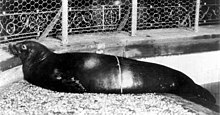
The extinction of the Caribbean monk seal was mainly triggered by overhunting in the eighteenth and nineteenth centuries to obtain the oil held within their blab,[37] fueled by the large need for seal products.[38] Equally early on as 1688, carbohydrate plantation owners sent out hunting parties to impale hundreds of seals every night for blubber oil to lubricate mechanism.[39] The Caribbean monk seals' docile nature and lack of an instinctive fear of humans made it an easy target,[40] and hunting only ended (in the 1850s) because the population was as well low for commercial utilize.[41] Overfishing of the reefs that sustained the Caribbean monk seal population likewise contributed to their extinction. Fish stock decline in the Caribbean starved the remaining populations.[42] Little was washed to protect the Caribbean area monk seal; by the time it was placed on the endangered species list in 1967, it was likely already extinct.[37]
References [edit]
- ^ a b Berta, A. & Churchill, Thou. (2012). "Pinniped Taxonomy: bear witness for species and subspecies". Mammal Review. 42 (3): 207–234. doi:10.1111/j.1365-2907.2011.00193.x.
- ^ Wozencraft, West. C. (2005). "Genus Monachus". In Wilson, D. Due east.; Reeder, D. M. (eds.). Mammal Species of the Earth: A Taxonomic and Geographic Reference (tertiary ed.). Johns Hopkins University Press. p. 598. ISBN978-0-8018-8221-0. OCLC 62265494.
- ^ Scheffer, Victor B. (1958). Seals, Bounding main Lions, and Walruses: A Review of the Pinnipedia. Stanford, California: Stanford University Press. p. 47. ISBN978-0-8047-0544-viii.
- ^ Scheel, Dirk-Martin; Slater, Graham J.; Kolokotronis, Sergios-Orestis; Potter, Charles W.; Rotstein, David S.; Tsangaras, Kyriakos; Greenwood, Alex D.; Helgen, Kristofer M. (2014). "Biogeography and taxonomy of extinct and endangered monk seals illuminated by ancient Dna and skull morphology". ZooKeys (409): 1–33. doi:10.3897/zookeys.409.6244. PMC4042687. PMID 24899841.
- ^ Jemison, Yard. (15 May 2014). "As well valuable to lose: Extinct relative reveals rarity of last two remaining monk seal species". Smithsonian Science website. Smithsonian Institution. Archived from the original on 2014-05-fifteen. Retrieved 15 May 2014.
- ^ Scheel, D. M.; Slater, Chiliad.; Kolokotronis, Due south. O.; Potter, C.; Rotstein, D.; Tsangaras, K.; Greenwood, A.; Helgen, K. M. (xiv May 2014). "Biogeography and taxonomy of extinct and endangered monk seals illuminated by ancient Deoxyribonucleic acid and skull morphology". ZooKeys (409): 1–33. doi:ten.3897/zookeys.409.6244. PMC4042687. PMID 24899841.
- ^ Dominion, James P.; Adams, Justin W.; Marx, Felix G.; Evans, Alistair R.; Tennyson, Alan J. D.; Scofield, R. Paul; Fitzgerald, Erich M. Thousand. (2020-11-11). "Kickoff monk seal from the Southern Hemisphere rewrites the evolutionary history of true seals". Proceedings of the Royal Lodge B: Biological Sciences. 287 (1938): 20202318. doi:ten.1098/rspb.2020.2318. PMC7735288. PMID 33171079.
- ^ Yarlagadda, Tara (13 November 2020). "Unusual Teeth Reveal A New Species And A Twist On Evolution". Changed . Retrieved fourteen November 2020.
- ^ Berta, Annalisa; Kienle, Sarah; Bianucci, Giovanni; Sorbi, Silvia (2015-01-02). "A Reevaluation of Pliophoca Etrusca (Pinnipedia, Phocidae) from the Pliocene of Italy: Phylogenetic and Biogeographic Implications". Journal of Vertebrate Paleontology. 35 (1): e889144. doi:10.1080/02724634.2014.889144. ISSN 0272-4634. S2CID 84460049.
- ^ "Historical Timeline of the Hawaiian Monk Seal" (PDF). Pacific Islands Regional Office (NOAA). Honolulu, HI, The states: National Marine Fisheries Service, Pacific Islands Regional Function. June 29, 2011. Retrieved nineteen November 2012.
- ^ Baker, J; Johanos, Thea C. (2004). "Abundance of the Hawaiian Monk Seal in the Main Hawaiian Islands". Biological Conservation. i. 116: 103–10. doi:10.1016/S0006-3207(03)00181-2.
- ^ a b M. Johnson, William; A. Karamanlidis, Alexandros; Dendrinos, Panagiotis; Fernández de Larrinoa, Pablo; Gazo, Manel; Mariano González, Luis; Güçlüsoy, Harun; Pires, Rosa; Schnellmann, Matthias (2006). "Monk Seal Fact Files". The Monachus Guardian.
- ^ a b c "Caribbean area Monk Seal (Monachus tropicalis)". NOAA – Office of Protected Resources. Retrieved 16 January 2016.
- ^ Gilmartin, William; Forcada, J. (2002). "Monk Seals". Encyclopedia of Marine Mammals, Eds: 756–759.
- ^ a b Encyclopedia of Marine Mammals, p. 741.
- ^ a b c d e f one thousand h Karamanlidis, A.; Dendrinos, P. (2015). "Monachus monachus". IUCN Red Listing of Threatened Species. 2015: eastward.T13653A45227543. doi:10.2305/IUCN.UK.2015-4.RLTS.T13653A45227543.en.
- ^ a b "Hawaiian Monk Seal (Neomonachus schauinslandi)". NOAA – Office of Protected Resource. Archived from the original on 13 January 2016. Retrieved sixteen January 2016.
- ^ a b Goodman-Lowe, GD (1998). "Nutrition of the Hawaiian Monk Seal (Monachus schauinslandi) from the Northwestern Hawaiian Islands during 1991 to 1994" (PDF). Marine Biology. 3. 132 (iii): 535–46. doi:10.1007/s002270050419. S2CID 84310964.
- ^ a b "Hawaiian Monk Seal". Marine Mammal Middle . Retrieved 16 June 2016.
- ^ Kenyon, KW; Rice, DW (July 1959). "Life History Of the Hawaiian Monk Seal". Pacific Scientific discipline. 13. hdl:10125/7958.
- ^ Bertilsson-Friedman, P (2006). "Distribution and Frequencies of Shark-inflicted Injuries to the Endangered Hawaiian Monk Seal (Monachus Schauinslandi)". Journal of Zoology. 268 (four): 361–68. doi:x.1111/j.1469-7998.2006.00066.x.
- ^ a b c Nutrient and Agriculture Organization of the Un (1978). "Pinnipeds species summaries". Mammals in the Seas: Report book ii. ISBN978-92-v-100512-v.
- ^ a b Ellis, Richard (2004). No Turning Back: The Life and Expiry of Animal Species . New York: Harper Perennial. p. 194. ISBN978-0-06-055804-viii.
- ^ a b c d Antonelis, GA; et al. (2006). "Hawaiian monk seal (Monachus schauins-landi): condition and conservation issues". Atoll Res Bull. 543: 75–101.
- ^ "Hawaiian Monk seal Monachus schauinslandi". National Geographic. ten March 2011. Retrieved 31 July 2016.
- ^ a b Schultz J, J. K.; Baker J; Toonen R; Bowen B (2009). "Extremely Depression Genetic Diverseness in the Endangered Hawaiian Monk Seal (Monachus schauinslandi)". Periodical of Heredity. 1. 100 (1): 25–33. doi:x.1093/jhered/esn077. PMID 18815116.
- ^ Kretzmann, Yard.; et al. (1997). "Low Genetic Variability in the Hawaiian Monk Seal". Conservation Biology. 11 (2): 482–490. doi:10.1046/j.1523-1739.1997.96031.x.
- ^ "2nd Revision of Recovery Programme for the Hawaiian Monk Seal (Monachus schauinslandi)" (PDF). NOAA PIFSC Hawaiian Monk Seal Inquiry. Honolulu, Hello, USA: Pacific Islands Fisheries Scientific discipline Middle (NOAA). Jan 28, 2010 [2007]. Retrieved sixteen January 2016.
- ^ Protected Resources Division." NOAA. N.p., n.d. Spider web. 21 October. 2013.
- ^ Gladden, Tracy. "Hawaiian monk seal is the new state mammal". KHNL NBC viii Honolulu Hawaii. Archived from the original on 27 January 2013. Retrieved 23 May 2011.
- ^ Karamanlidis, A.A.; Dendrinos, P.; P.F. de Larrinoa, A.C. Gücü; Johnson, W.G.; Kiraç, C.O.; Pires, R. (2015). "The Mediterranean monk seal Monachus monachus: status, biology, threats, and conservation priorities". Mammal Review. 45 (4): 92. doi:x.1111/mam.12053.
- ^ Tiwari Grand., Aksissou M., Semmoumy S., Ouakka Yard. (2006). Morocco Footprint Handbook. Footprint Travel Guides. p. 265. ISBN978-1-907263-31-vi.
{{cite book}}: CS1 maint: uses authors parameter (link) - ^ Pastor, T.; et al. (2004). "Low Genetic Variability in the Highly Endangered Mediterranean Monk Seal". Journal of Heredity. 95 (4): 291–300. doi:10.1093/jhered/esh055. PMID 15247308.
- ^ "MOm Website" (in Greek). mom.gr. Retrieved xi June 2012.
- ^ "Important Moments for NMPANS" (in Greek). mom.gr. Archived from the original on 5 March 2016. Retrieved sixteen January 2016.
- ^ "International Monk Seal Brotherhood". Sualtı Araştırmaları Derneği: Akdeniz Foku Araştırma Grubu . Retrieved 15 June 2016.
- ^ a b Adam, Peter (July 2004). "Monachus tropicali". Mammalian Species. 747: 1–9. doi:10.1644/747.
- ^ Encyclopedia of Marine Mammals, pp. 585–588.
- ^ Greyness, J (1850). Catalogue of the Specimens of Mammalia in the Collection of the British Museum. London. p. five.
- ^ Ward, H (1887). "The West Indian Seal (Monachus Tropicalis)". Nature. 35 (904): 392. Bibcode:1887Natur..35..392W. doi:10.1038/035392a0. S2CID 4065385.
- ^ Gray, J (1850). Catalogue of the Specimens of Mammalia in the Collection of the British Museum. London. p. v. doi:10.5962/bhl.title.20968
- ^ McClenachan, Loren; Cooper, Andrew B. (2008). "Extinction rate, historical population structure and ecological role of the Caribbean monk seal". Proc. R. Soc. B. 275 (1641): 1351–1358. doi:10.1098/rspb.2007.1757. PMC2602701. PMID 18348965.
Further reading [edit]
- Ronald Grand. Nowak (1999), Walker's Mammals of the Globe (6th ed.), Baltimore: Johns Hopkins University Press, ISBN978-0-8018-5789-eight, LCCN 98023686
- Perrin, William F.; Bernd Wursig; J. G. Thou. Thewissen (2008). Encyclopedia of Marine Mammals. Academic Printing. ISBN978-0-12-373553-nine.
External links [edit]
 | Wikimedia Commons has media related to Monachus. |
- The Monachus Guardian
- Monk Seal Foundation
- NOAA Monk Seal Info
ostrandermationdeed52.blogspot.com
Source: https://en.wikipedia.org/wiki/Monk_seal
0 Response to "How Big Is a Baby Monk Seal How Heavy?"
Postar um comentário