Why Would It Even Be Useful to Modulate a Power Supply Fan According to Temperature Readings
Introduction
As IC designers strive to put more transistors running at higher speeds into smaller packages, there can exist merely ane outcome: oestrus! Couple this with the fact that these high-power ICs are beingness designed into ever-shrinking boxes, and you finish up with a existent thermal direction problem. For many applications, this means using fans. Unfortunately with fan employ comes the usual fan headaches of mechanical failures, increased power consumption, and more noise. Fan speed command and monitoring can ease some of these headaches, resulting in quieter, more reliable fans that use less power.Brushless DC Fans
Before we go into the bailiwick of regulating and monitoring fans, nosotros first need to sympathise the fans themselves. Brushless DC fans tend to exist the solution of option for near electronic enclosures. These fans couple high reliability with ease of use. The basic DC brushless fan is a 2-wire device over which a DC voltage is applied. That is all it takes. The simplest arroyo to arrangement cooling is to connect a fan to a DC power supply and let information technology run. A quick glance at fan catalogs reveals that fans operating at a nominal 5V, 12V, 24V, or 48V are available. Currently, 12V fans seem to be the most widely used. Every bit more systems are designed without a 12V ability supply, 5V fans will likely become more prevalent. In telecom applications, 48V fans are especially pop.Brushless DC fans are chosen "brushless" because the electric motor inside the fan is commutated electronically. Older DC fans used mechanical brushes, which can cause increased electromagnetic interference (EMI) along with dust particles due to mechanical vesture throughout the system. Over fourth dimension, the fan would article of clothing and eventually fail. Brushless fans have replaced these mechanical brushes with electronic sensors and switches that now perform the necessary commutation. This exchange circuitry is mounted within the fan itself and is totally transparent to the user. The cease result is a unproblematic-to-utilize, reliable, 2-wire device. This has greatly increased the lifetime and the reliability of these fans.
To the end user, DC brushless fans are fairly simple to characterize electrically. As the DC voltage applied to the fan is varied, its speed and current draw also vary. To a get-go social club, speed and current are directly proportional to the DC voltage applied. See Figures ane and 2.
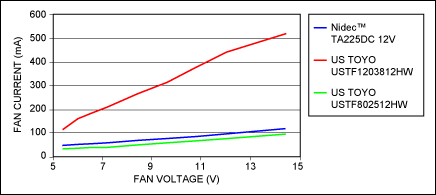
Figure 1. Fan current versus fan voltage (12V-rated fans).
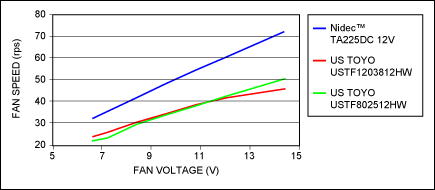
Figure 2. Fan speed versus fan voltage (12V-rated fans).
Fan-Monitoring Options
Although brushless exchange has gone a long way in increasing the lifetime and the reliability of fans, they are still mechanical devices and prone to mechanical wear and failure. Over time, fan speed and therefore cooling efficiency can slowly dethrone or fail completely. This is why it tin can be important to continuously monitor the condition of the fan. Most fan manufactures offer a diverseness of means to practice this. These options fall into roughly ii categories: alert sensors and speed sensors. Alert sensors typically give a digital bespeak indicating that the fan has fallen beneath some threshold of speed or has stopped birthday. As ane instance, ebm-papst Inc. offers an pick that generates a series of depression-going digital pulses whenever the speed of the fan drops to 75% to 85% of its nominal speed. NMB Technologies offers a slightly dissimilar option that information technology calls a "Locked Rotor Alarm Point." This signal goes high whenever the fan stops spinning completely.Manufacturers besides offer fans with speed sensors that give a digital output whose frequency is proportional to the fan speed. The most common speed sensor gives two pulses per revolution. Depending on the manufacturer and the options offered, both speed and alert sensors can be ordered with either open-collector or internally pulled-up outputs. Internally pulled-up outputs tin can be TTL-compatible or can swing the full supply voltage of the fan. Figure three shows the output stages available from ebm-papst Inc. It is important to note that the alarm and speed sensors share the same supply voltage as the motor and its commutation electronics. Any changes in supply voltage to control the speed of the fan will also affect the exchange electronics and the speed/alert sensors.

Figure 3a. This speed-sensor output is an open collector with a weak pullup resistor, and not necessarily TTL-compatible.

Figure 3b. The zener diode connected to this speed-sensor output ensures TTL compatibility.

Figure 3c. This open-collector speed-sensor output allows maximum flexibility at the minor expense of an external pullup resistor.
Why Use Speed Command?
When a fan is selected for an awarding, it must be designed for worst-instance conditions. This means selecting a fan that can move enough air to go along the system sufficiently cool, even with worst-case ambient temperature, power dissipation, fan product tolerances, and fan aging. The reality of the situation is that the system will spend virtually of its time well nether worst-case weather condition. At this point, it should be obvious that under most conditions, fan speed can be reduced without adverse effects on the system and increased simply when weather condition need it. Not and so obvious is why bother then with fan speed control?Reduced Aural Dissonance
One of the most immediately noticeable advantages of fan speed control comes in the grade of relief for your ears. Fans running at full speed can exist a significant source of annoyance, especially for equipment used in serenity office environments. About offices are unremarkably at a temperature significantly less than electronic equipment is designed to operate up to, which means fan speed tin exist reduced without adverse furnishings, much to the relief of everyone inside hearing distance.Reduced Ability Consumption
Applications such every bit laptops will do good from reduced ability consumption. Figure iv shows typical power consumption versus fan speed for 3 different fans. Power consumption tin can be approximated as a foursquare of the fan's speed. In the case of the Nidec fan in Effigy four, reducing the fan speed to 69% of its nominal at 12V cuts ability consumption in one-half. 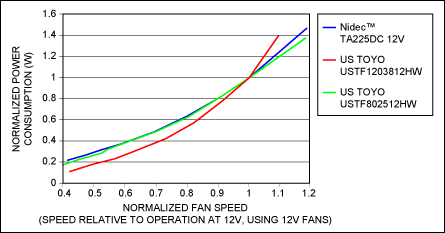
Figure 4. Power consumption versus fan speed.
Increased Lifetime
Reducing fan speed also decreases the wear on the fan. Fan wear is a crude role of the absolute number of revolutions of the fan. Reduced wear translates into increased lifetimes and therefore greater mean time between failures (MTBFs). Because fans are mechanical, they tend to be one of the more common failures in a organisation. Anything that tin be done to improve the MTBF for a fan will also cause a pregnant increase of MTBF in the end equipment. This can exist specially of import in systems such as servers and networking equipment.Reduced Clogging
As anyone who has opened up former equipment knows, dust seems to be attracted to electronics, specially in systems with fans. As dust collects at the inlet and the exhausts of systems with fans, airflow tin can diminish or be stopped altogether. This, of course, can effect in decreased cooling and higher temperatures. Reduced fan speed can lessen the rate at which systems collect this grit, thus extending the system's life.Methods of Speed Command
Now that we better understand DC brushless fans, their available options, and the benefits of speed control, we will expect at 3 methods of decision-making speed. Each method offers a trade-off when information technology comes to cost versus performance.Direct PWM
Pulse-width modulating (PWM) the fan directly involves turning the fan's ability supply on and off at a fixed frequency. Duty-bicycle adjustments are made to command the speed of the fan. The larger the duty cycle, the faster the fan spins. Choosing the appropriate frequency for this method can exist somewhat tricky. If the frequency of the PWM signal is likewise deadening, the fan's speed will noticeably oscillate within a PWM cycle. To illustrate this point, take the ridiculous extreme of a 50% duty-wheel, 0.01Hz drive signal. The fan will spin to full speed during the outset fifty seconds and then stop within the next fifty seconds. The frequency can too be too high, as substitution is done electronically using circuits that are powered off the fan's plus and minus terminals. Using PWM with the fan and therefore the internal commutation electronics too quickly tin crusade the internal substitution electronics to cease performance correctly. Call back that these electronics were non designed to run on anything but DC supplies. Thus, useful frequencies range from 20Hz to 160Hz. In addition, the PWM ascent and fall times must be sufficiently slow to ensure long-term reliability of the fan.Equally with all things, applying PWM directly has its advantages and disadvantages. The advantages include a very unproblematic drive circuit (run into Figures 8a and 8b), good startup characteristics, and minimal rut dissipation in the laissez passer transistor. The disadvantages involve increased stress on the fan and the disability to use speed or alarm sensors. Note that speed and warning sensors are powered off the same supply voltage every bit the motor. Considering the supply voltage is being powered on and off at a 20Hz to 160Hz rate, the speed and alarm circuitry is besides existence powered up and down, effectively rendering the speed and alarm sensors useless.
During PWM control, the voltage applied to the fan is either its rated voltage (12V in the example of a 12V fan) or 0V. All the same, because the fan is spinning at something less than its rated speed (remember, that is the whole idea), its dorsum EMF is reduced. This causes higher-than-nominal current flow through the windings during the on period of the PWM wheel. Although fans are designed to handle increased currents, such as during startup, heightened currents at xxx times per second for the life of the fan tin entail negative reliability issues. Simply even with these negatives, PWM control tin can be the advisable solution in depression-cost noncritical applications.
Linear Regulation
As the term implies, "linear regulation" adjusts the DC voltage across the fan by using a linear regulator. When using this method, it is of import to make sure the fan is specified to operate over a broad range of voltages. One major advantage linear regulation has over PWM is that information technology allows the use of speed and alarm sensors. Unfortunately, linear regulation also has its drawbacks: mainly power dissipation in the pass element, every bit well as startup and stalling bug.Linear regulators command the DC voltage across the fan. They do this by dissipating power in the form of heat. It probably seems lightheaded to generate estrus in lodge to cool something downwardly. But it is not as ridiculous every bit you might call back. During maximum and minimum cooling, ability dissipation volition ideally be zero. During maximum cooling, the pass element is fully on, so the voltage across it is near zero. Zero volts means cypher power dissipation. During minimum cooling, the pass element is off (zero current flows), so over again ability dissipation is zero. Equally previously discussed, the current describe of the fan can be approximated as a linear office of the voltage applied, making it look resistive. With this in mind, worst-case power dissipation occurs roughly when the voltage across the fan is one-one-half its maximum operating voltage. See Effigy 5. This means worst-case power dissipation in the laissez passer element can be estimated by the following equation: P = 1/4(VMAX × IMAX), where IMAX and VMAX are the rated voltages and currents of the fan, respectively. For case, a i.2W fan (12V at 98mA) will accept worst-case power dissipation across the pass element of simply 300mW when running at 6V with a 12V supply. Information technology is comforting to notation that maximum heat dissipation in the fan circuit occurs during minimal cooling requirements. Also, fifty-fifty though a ability-dissipating device is beingness used, at that place is even so an overall power savings when fan speed is reduced. Come across Effigy 6.

Figure 5. Power dissipation in a linear-regulator pass chemical element versus fan supply voltage.

Figure 6. Total power consumption of a linearly regulated fan excursion.
Startup and stall issues are related. Fans require a sure voltage before they will start. This is chosen "startup voltage." Once a fan is already spinning, decreasing the voltage below the stall voltage will cause the fan to cease. The startup voltage is equal to or (usually) greater than the stall voltage. Typically they are 25% to l% of the rated voltage for the fan. When linear regulation is used without speed monitoring, at that place is no fashion of knowing if a fan has stalled or fifty-fifty started.
In that location are several solutions to this trouble. 1 is to forbid voltages across the fan from going lower than the startup voltage. Although this is easily achieved in software, selecting the correct voltage to ensure proper startup for all fans and accounting for aging tin limit the useful range of speed control. You might accept to choose a minimum worst-example voltage of sixty% nominal to make certain all fans volition start. This tin exist wasteful, considering that the average fan might easily be controlled down to 40%. Another solution is to use a fan with a tachometer. The tachometer can now exist monitored past a microcontroller, allowing software to know when a fan has not started or if it has stalled. Although this method is significantly more robust and less wasteful, it requires design fourth dimension and additional hardware/software resources.
DC-DC Regulation
DC-DC regulation is similar to linear regulation in that it controls the speed of the fan past adjusting the DC voltage across it. However, dissimilar a linear regulator, a DC-DC regulator uses a switch-mode power supply. Because both methods control speed by adjusting the DC voltage, both tend to take the same advantages and disadvantages. The one exception, still, is that DC-DC regulators are ideally 100% efficient and do not generate any rut (real-globe efficiencies tend to be around 75% to 95%). The punishment for this efficiency is increased cost and complication (run into Figures 8e and 8f). Fifty-fifty though DC-DC regulators tend to be more efficient, at full fan speeds there will exist no real power savings (see Figure 7). Real gains from the employ of DC-DC regulators occur just when fan speeds are reduced from their maximum. Maximum efficiency benefits occur when the voltage beyond the fan is one-half of the maximum available voltage. This occurs for the same reason that linear regulators dissipate their maximum at the same i-half of the supply voltage. Because of the increased toll and complexity of DC-DC converters and the express power savings, DC-DC regulators are usually reserved for bombardment-powered systems or systems that utilise loftier-power fans or a large number of fans. Equally always, with all DC-DC converters, care must exist taken during layout. 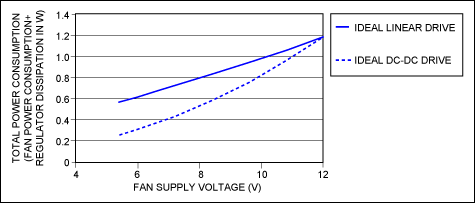
Figure vii. Total power consumption of the Nidec TA225 12V fan plus bulldoze circuitry.
High-Side versus Low-Side Bulldoze
All iii methods above tin can be designed using a high-side or depression-side bulldoze transistor (see Effigy 8). High-side drive requires slightly more circuitous circuitry due to level translation, but it has the advantage of keeping the fan's negative terminal at ground. Therefore, speed and alarm sensors are now footing-referenced and it is easier to interface to them.Contrastingly, depression-side drive does not require a level translator for the drive transistor, but will need some blazon of translation for speed and alarm sensors. With a depression-side drive transistor, the positive terminal of the fan is kept at a constant 12V (assuming a 12V fan), while the negative terminal of the fan is adjusted up and downwardly to control speed. Unfortunately, speed and warning sensors share the fan'due south negative terminal and go adapted along with fan speed, resulting in the need for level translation.
Applications Information
Speed Control Without a Tachometer
Figures 9 and 10 give two examples of fan circuits designed for systems that practise non require an warning or speed sensor. In Figure 9, the MAX1669 is configured to drive the fan in PWM style. Figure 10 shows the MAX1669 configured for DC linear style.The MAX1669 is both a temperature sensor and a fan controller.

Figure 9. The MAX1669 drives the fan in PWM mode.
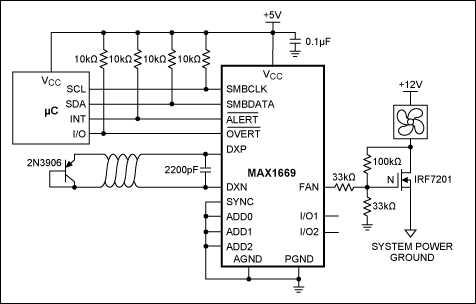
Figure 10. The MAX1669 configured for DC linear manner.
These two blocks work independently from each other and are intended for apply with a microcontroller. Advice betwixt the MAX1669 and the microcontroller is washed via an SMBus-compatible interface. The SMB interface is a 2-wire serial interface, which is very similar to and usually backward-compatible with the I²C interface.
The MAX1669 reports external temperatures using a remotely mounted diode. Figures 9 and 10 show a MAX1669 using a 2N3906 continued as this diode. A similar diode is sometimes included on the die of some ICs. An case is the Virtex® family unit of parts. These devices have ii pins labeled DXN and DXP. Connecting the MAX1669 straight to these pins permits information technology to measure out die temperature directly. This allows the fan circuit to control a particular IC'southward die temperature more than tightly. It also eliminates worries about mounting temperature sensors to IC packages, thermal fourth dimension constants, and having to practise thermal resistance calculations.
This circuit (and others discussed) either runs as open or closed loop with respect to temperature. When running as open loop, the temperature sensor measures ambience temperature by mounting the sensor at the inlet of the unit. Every bit the ambience temperature rises, fan speed is increased nether software command. In this configuration, increasing or decreasing the fan speed volition ideally have no effect on the measured temperature. Thus, the system has no course of thermal feedback and is open loop. Considering it is open up loop, in that location are no stability problems, resulting in a simpler software design. However, there is no direct way of knowing the actual temperature of the components that demand to be cooled. If cooling efficiency is reduced due to partially clogged inlets or fan crumbling, for example, this type of command would have no fashion of knowing and therefore compensating for it. This means the system must be designed and so that the fans spin faster than what is required, resulting in a less-than-optimum organisation.
Placing the temperature sensor in a location that the fan is designed to cool forms a closed-loop arrangement. Increasing the fan's speed results in a drib of the measured temperature. This now requires attention to stability problems. Such attention leads to longer development time and greater software complexity, but rewards you with a direct and tighter control of your heat source. Now fan speed tin be regulated at the minimum speed necessary to keep disquisitional components beneath a predetermined temperature. In addition, there volition be automatic compensation for problems such every bit partially clogged inlets and outlets. In both cases, the hardware pattern is the same. The only difference is the placement of the temperature sensor and the software code.
Speed Control with a Tachometer
The above circuits piece of work well in lower-terminate systems where we are not overly concerned with reliability. However, in systems in which we place a premium on reliability, these circuits can fall short. In the case of open-loop temperature command, the arrangement has no way to detect any blazon of fan failure. Elevated temperatures in closed-loop control can be used as an indication, however there is still room for improvement. Elevated temperatures bespeak a organization problem, only cannot distinguish betwixt clogged inlets and outlets, high ambient temperatures, excessive internal rut dissipation, or fan failures. In improver, as heat is the primary indication of problems, it may have a while earlier these bug are noticed, due to tiresome thermal response. An case would be a pencil suddenly getting stuck in the fan. It may take several minutes before the temperature rises high enough for the problem to be flagged.Tachometer outputs (speed sensors) can address these issues. Figure 11 shows a circuit that uses a fan with a tachometer. The MAX6625 measures the temperature and reports it to the microcontroller via an I²C-compatible 2-wire interface. The same 2-wire interface issues commands to the MAX6650, which controls the speed of the fan. The MAX6650 has all the necessary level translation and hardware to interface with the fan's open-collector tachometer. Fan speed tin can be read over the SMBus-compatible interface as a byte-broad integer.
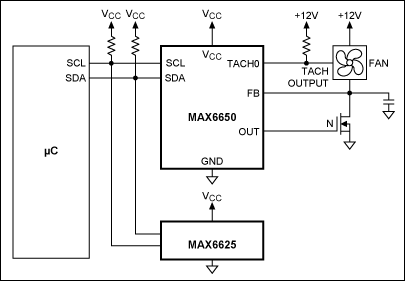
Figure 11. The MAX6650 interfaces to fans with tachometer outputs to monitor and control fan speed. The MAX6625 tin can be connected to the same I²C-uniform bus to monitor temperature.
The MAX6650 can work as a fan-speed controller or a fan-speed regulator. The difference is a subtle only of import one. A fan speed controller controls the voltage beyond the fan and therefore indirectly controls its speed. A fan speed regulator actually measures and regulates the speed of the fan using its tachometer. When the MAX6650 is used as a fan speed controller, a microcontroller reads the temperature from the MAX6625 and the fan speed from the MAX6650 via the SMBus-compatible interface. The microcontroller and then issues DAC codes to the MAX6650. These DAC codes directly control the voltage across the fan and thus indirectly command its speed. The microcontroller must so constantly read the fan speed via the MAX6650 and make adjustments to the DAC to proceed the fan's speed in regulation. This becomes specially important effectually the startup and stall speeds of the fan.
When the MAX6650 is configured equally a fan speed regulator, the microcontroller issues speed commands. The MAX6650 automatically monitors and adjusts the speed of the fan to proceed it within regulation. In one case a desired speed is written, no further interest by the microcontroller is required. This reduces software overhead significantly. If the MAX6650 cannot maintain the desired speed, it tin can generate an alarm in the grade of an interrupt to the microcontroller.
Similar to the circuits in Figures nine and ten, the circuits in Figure 11 and Figure 12 can be made to run in temperature open- or closed-loop systems. It is of import to note that in a temperature closed-loop organisation, at that place are now ii closed loops: one for temperature regulation and the other for fan speed regulation. Additional care must be taken to foreclose stability problems.
Because fan control typically relies on a microcontroller, information technology too depends on software. Software can exhibit many types of problems, including loops of an infinite diverseness. In PC-based systems, viruses can even intentionally crusade issues. Such bug tin can require some type of backup to foreclose damage. Figure 12 shows such a backup.
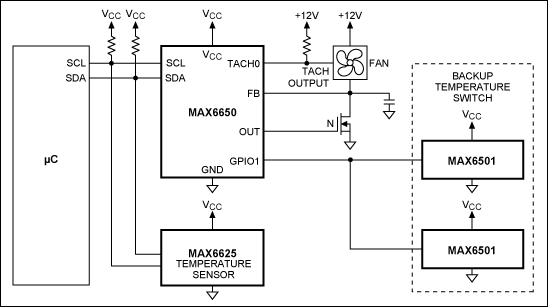
Figure 12. Adding a MAX6501 temperature switch to the excursion in Figure 11 provides a fail-safe temperature backup that works independent of software.
The MAX6501 is a small, inexpensive, digital-output temperature sensor. When the temperature rises in a higher place a sure threshold, its output pulls depression. The MAX6650 can exist configured to monitor its full general-purpose input/output (GPIO1) pin so that when it gets pulled depression, the device volition automatically turn the fan on full speed. This will happen independently of commands issued via software. Past strategically placing the MAX6501 in critical areas, problems can be avoided. Information technology is interesting to note that this type of backup protection not only will protect confronting software problems but besides confronting less likely primary temperature-sensor failure and microcontroller-hardware failure. Because the MAX6501 has an open-collector output, multiple devices can be tied together and mounted in several places within the unit. This allows multiple disquisitional locations to be protected at in one case.
Multiple Fans Controlled as a Group
Effigy 13 is a variation of Figure xi. It is sometimes desirable to control multiple fans as a unmarried group. Figure 13 shows the MAX6651 controlling three fans as ane unit. The MAX6651 is similar to the MAX6650, but has additional GPIOs and tachometer-monitoring inputs. Every bit all three fans are run in parallel, independent speed regulation of each fan is non possible. I fan must be chosen as a principal, around which any speed regulation loop is closed. When in regulation mode, the MAX6651 closes the speed loop around the fan connected to TACH0. When the MAX6651 is used every bit a fan speed controller, the microcontroller tin close the loop around any ane of the fans. Although the MAX6651 does not directly regulate the speed of the remaining fans, they will tend to run at similar speeds if identical fans are used. To ensure that the unregulated fans are working properly, the MAX6651 allows the microcontroller to read the speed of each fan via the SMBus-compatible interface. This way, if whatever one fan drops out of tolerance, the user can be flagged. The MAX6651 can directly interface to up to iv fans. 
Figure 13. The MAX6651 controls three fans as one unit.
Figure xiv shows how to use an analog multiplexer to monitor more than than four fans. GPIO2, GPIO3, and GPIO4 are configured equally outputs. These bits tin exist toggled via the SMBus-compatible interface to control which fan's tachometer gets connected to the TACH3 input.

Effigy xiv. This diagram shows how to use an analog multiplexer to monitor more than four fans.
N+1 and Hot-Swap Application
When a problem does occur with a fan, advisable activeness needs to exist taken. Sometimes shutting the system down to prevent damage is all that is required. Nevertheless, in systems that demand to minimize downtime, this is not a very attractive option. Effigy 15 shows an application allowing systems to continue to run fifty-fifty during a fan failure. This circuit uses a technique commonly called N+1. N+1 is the practice of using ane more fan than is actually needed nether worst-case atmospheric condition. This allows sufficient cooling to occur if any ane fan fails. In improver, all fans should exist placed on separate cards and designed so they can be hot-swapped in and out. This allows a bad fan to be removed and replaced while the unit is running, preventing any downtime. 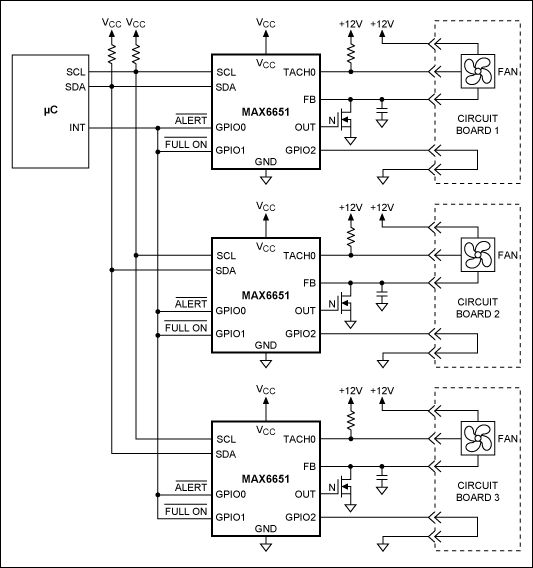
Figure 15. When used in an North+one application, the MAX6651 can exist configured to automatically run all good fans at full speed if one should fail. As well shown is how to configure the circuit to allow for hot swapping.
Under nearly circumstances, more fans are running than are actually required, so reducing fan speed becomes even more relevant. Nonetheless, in the event of a fan failure, the remaining fans need to spin at maximum speed. As well, the user needs to be notified to remove and replace the bad fan.
In Figure 15, the MAX6651s are configured via the SMBus-compatible interface to generate a logic depression on GPIO0 whenever they cannot maintain their requested fan speeds. These outputs (which are open up-bleed with internal pullups) are tied together. Thus, whatsoever one of the three fans that cannot be maintained at the desired speed (due to failure) volition cause this line to get depression. This same line is and then tied to all the GPIO1 pins. These pins are configured as inputs that will plow their respective fans on full speed when a logic depression is applied. This mode, a fan failure automatically results in all fans spinning at full speed. Another do good is that no involvement is required from the microcontroller.
It may be desirable for the microcontroller to exist interrupted whenever a problem occurs. This is easily accomplished past connecting GPIO0 to the interrupt pivot, as shown. By doing this, the microcontroller can now determine which fan has failed by reading their speeds via the SMBus-compatible interface. With this cognition, information technology can flag the user to replace the appropriate fan. GPIO2 of the MAX6651 tin can be read via the SMBus-compatible interface (or through an input pin on the microcontroller if available) to observe when a fan is removed or plugged in.
Synchronizing Fans
Systems that utilize multiple fans can experience an boosted source of noise irritation due to beat frequencies betwixt fans. Similar to the issue experienced in multiple-engine airplanes, two fans that are spinning at slightly unlike speeds volition cause a beating dissonance. The frequency of the noise is related to the deviation in speed. This effect can be subtle and is unremarkably not a concern when information technology comes to most units. However, with college-terminate systems, we may desire to get rid of as much noise irritation as possible. The obvious solution is to spin the fans at exactly the same speed. Effigy 16 shows an awarding doing just that. 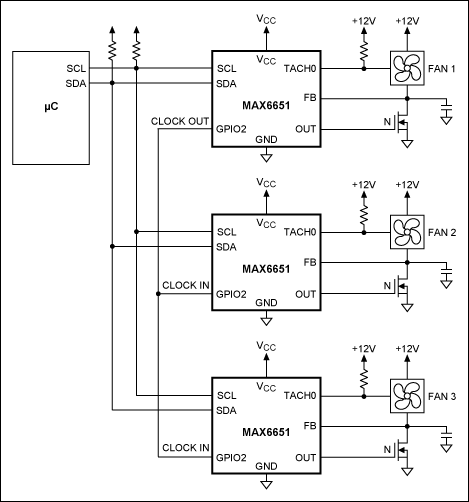
Figure sixteen. With this awarding, the MAX6651s are configured to use the same oscillator, minimizing any speed variations between fans. This lessens beating noises constitute in multiple fan systems.
The primary problem with trying to go independent fans to spin at the same speed is that each MAX6651 has its own time base (oscillator frequency). These time bases are authentic enough to control fan speeds individually, only not accurate enough to prevent chirapsia from occurring in multiple-fan systems. By configuring all the MAX6651s to apply the same oscillator, this source of error is eliminated. To facilitate this, the MAX6651 tin configure its GPIO2 pin to role equally either an oscillator input or output. By configuring the first MAX6651 as a clock output and the rest as clock inputs, they will all run off the aforementioned frequency. At present with all parts running with the same clock, tight speed tolerances are doable.
Conclusion
Fan speed control is useful for increasing the reliability, reducing the power consumption, and decreasing the noise of systems. Many dissimilar circuits and options tin can be selected in terms of trade-off in price and operation. This article provides some insight and possible solutions regarding various issues that have to practise with implementing such control.ostrandermationdeed52.blogspot.com
Source: https://www.maximintegrated.com/en/design/technical-documents/tutorials/1/1784.html
0 Response to "Why Would It Even Be Useful to Modulate a Power Supply Fan According to Temperature Readings"
Postar um comentário